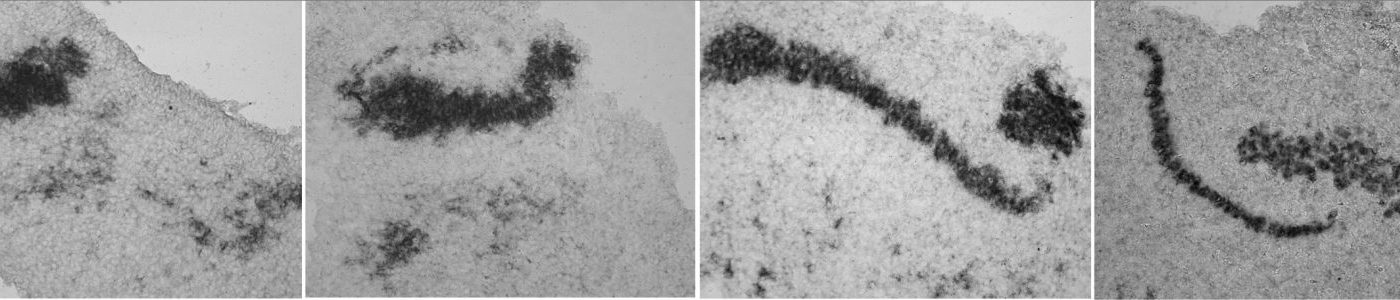
Most neural circuits rely on the precision with which connections between different neurons occur, in addition to very subtle changes in the physiology of the individual neurons that affect the conditions in which they will fire action potentials. Developmental Neurobiology can make a huge contribution to understanding the functioning of the nervous system through investigation of how the molecular anatomy of circuits within the brain are set up.
We study the effects of developmental process including signalling between cells through secreted factors and cell-cell adhesion on the formation and function of two types of circuit found within the brain stem: those circuits involving cranial motor neurons and the auditory circuitry that integrates information from the two ears.
The auditory circuit that we are studying helps to locate sound sources in space and illustrates beautifully how development is instrumental in shaping function. A major cue for an animal to locate sound sources compares the arrival time of the sound at the two ears. The time difference in sound reaching each ear, termed interaural time difference (ITD), varies from zero (sound directly ahead) to approximately 300 microseconds (depending on the size of head). The circuit operates as an ‘AND’ logical gate where synaptic input from the ear closest to the sound sets up a map of space along an array of neurons which is compared to synaptic input from the ear furthest away from the sound. This identifies the location of sound in a subset of neurons along this array through dendritic integration to detect temporal coincidence of the two inputs. This calculation is performed at each characteristic frequency of sound using different arrays of neurons that are juxtaposed to form a sheet of cells in the brain stem.
The Price lab is relatively small with five members, each person with their own defined project related to specificity of cell communication in the brainstem and spinal cord.
Additionally, we conduct education research around how school pupils engage with current Biosciences research.
Research is more about asking questions than it is about finding answers.
Is this actually true? I think it might be but the central reason for posing the question is to find out if it finds its way onto google! Also, is what my education research is about really simply about whether school pupils realise that research is at least as much about asking the right question than it is about finding the right answers. In that light, then the statement above could be true. Additionally, once you invoke the caveat that there should be a right question with concomitant right answer(s) then it poses the question of “who is judging the correctness of the question or answer?” One could argue that, in the sciences, the right answer becomes clear over time. But what of the right question? Aren’t those constructed based on a political agenda on what is most important. Thus- by posing the above, one could argue that we are actually getting rather political in an apparent innocuous statement.
 Stephen R Price